reference to : http://blog.csdn.net/happy_horse/article/details/51518280
最近项目中涉及到加载本地的地名.db文件,数据量大,自然不能直接放在UI线程中操作,好在Google在Android3.0以后,提供了AsyncTaskLoader来做一些耗时的异步任务。
一 官方对AsyncTaskLoader的定义及特点介绍如下:
Abstract Loader that provides an AsyncTask to do the work
Introduced in Android 3.0, loaders make it easy to asynchronously load data in an activity or fragment. Loaders have these characteristics:
1、They are available to every Activity and Fragment.
//支持Activity和Fragment
2、They provide asynchronous loading of data.
//异步下载 (就是不影响UI线程)
3、They monitor the source of their data and deliver new results when the content changes.
//当数据源改变时能及时通知客户端
4、They automatically reconnect to the last loader’s cursor when being recreated after a configuration change. Thus, they don’t need to re-query their data.
//发生configuration change时自动重连接
二 实际项目介绍
下面引用官方的一个展示当前设备所有已安装应用程序的DEMO,来对AsyncTaskLoader的用法做一个详细的介绍:
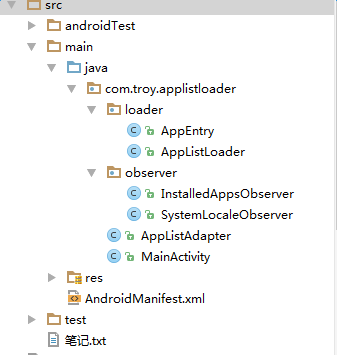
项目结构如图:
第一步:我们需要写一个对应于每一个应用程序的实体类,该实体类包含应用程序图标和标签两个属性。
AppEntry.java:

/*** Created by Administrator on 2016/5/25.*/
public class AppEntry {private String mLabel;//应用文字标签private Drawable mIcon;//应用图标private final AppListLoader mLoader;private final ApplicationInfo mInfo;//<application>节点信息,只有一个//PackageInfo、ApplicationInfo、ActivityInfo、ResolveInfo四种信息类的一种private final File mApkFile;private boolean mMounted;public AppEntry(AppListLoader mLoader,ApplicationInfo mInfo ) {this.mInfo = mInfo;this.mLoader = mLoader;mApkFile=new File(mInfo.sourceDir);//sourceDir=Full path to the location of this package
    }public ApplicationInfo getApplicationInfo() {return mInfo;}public String getLabel() {return mLabel;}public Drawable getIcon() {if (mIcon == null) {if (mApkFile.exists()) {mIcon = mInfo.loadIcon(mLoader.mPm);//public Drawable loadIcon (PackageManager pm){}获取应用图标return mIcon;} else {mMounted = false;}} else if (!mMounted) {// If the app wasn't mounted but is now mounted, reload its icon.if (mApkFile.exists()) {mMounted = true;mIcon = mInfo.loadIcon(mLoader.mPm);return mIcon;}} else {return mIcon;}return mLoader.getContext().getResources().getDrawable(android.R.drawable.sym_def_app_icon);//否则返回默认的小机器人
    }@Overridepublic String toString() {return mLabel;}void loadLabel(Context context) {if (mLabel == null || !mMounted) {if (!mApkFile.exists()) {mMounted = false;mLabel = mInfo.packageName;//获取程序名称} else {mMounted = true;CharSequence label = mInfo.loadLabel(context.getPackageManager());mLabel = label != null ? label.toString() : mInfo.packageName;}}}
}
第二步:需要写一个自己的AppListLoader ,继承自AsyncTaskLoader,并实现其相关抽象方法。
(1)onStartLoading:注册一些监听器到loader上,并且执行一次forceLoad(); 否则loader不会开始工作
(2)loadInBackground:不用说,在这里就是加载数据并且返回,其实这个数据就返回到了LoaderManager的onLoadFinished方法第二个参数
(3)onStopLoading:停止加载数据,但不要停止监听也不要释放数据,就可以随时重启loader
(4)onReset:先确保已经停止加载数据了,然后释放掉监听器并设为null
(5)onCanceled: 在这里可以释放资源,如果是list就不需要做什么了,但是象cursor或者打开了什么文件就应该关闭一下;
AppListLoader .java:
public class AppListLoader  extends AsyncTaskLoader<List<AppEntry>> {private static final String TAG = "ADP_AppListLoader";private static final boolean DEBUG = true;final PackageManager mPm;//包管理器private List<AppEntry> mApps;//装在应用程序实体的容器// An observer to notify the Loader when new apps are installed/updated.private InstalledAppsObserver mAppsObserver;//非系统应用程序安装或者卸载的广播接收器// The observer to notify the Loader when the system Locale has been changed.private SystemLocaleObserver mLocaleObserver;//系统应用程序安装或者卸载的广播接收器public AppListLoader(Context context) {super(context);mPm = getContext().getPackageManager();Log.i("TAG","AppListLoader(Context)");}@Overrideprotected void onStartLoading() {Log.i("TAG","onStartLoading()");if(mApps!=null){deliverResult(mApps);}// Register the observers that will notify the Loader when changes are made.if (mAppsObserver == null) {mAppsObserver = new InstalledAppsObserver(this);//注册一个非系统应用程序的接收器
        }if (mLocaleObserver == null) {mLocaleObserver = new SystemLocaleObserver(this);//注册一个系统应用程序的接收器
        }if (takeContentChanged()) {forceLoad();} else if (mApps == null) {forceLoad();//强制加载数据
        }}@Overridepublic void forceLoad() {Log.i("TAG","forceLoad()");super.forceLoad();}@Overridepublic List<AppEntry> loadInBackground() {Log.i("TAG","loadInBackground()");List<ApplicationInfo> apps=mPm.getInstalledApplications(0);
//        public static final int FILTER_ALL_APP = 0; // 所有应用程序
//        public static final int FILTER_SYSTEM_APP = 1; // 系统程序
//        public static final int FILTER_THIRD_APP = 2; // 第三方应用程序
//        public static final int FILTER_SDCARD_APP = 3; // 安装在SDCard的应用程序 if(apps==null){apps=new ArrayList<>();}List<AppEntry> entries=new ArrayList<>(apps.size());//开始加载数据for(int i=0;i<apps.size();i++){AppEntry appEntry=new AppEntry(this,apps.get(i));appEntry.loadLabel(getContext());entries.add(appEntry);}//Sort the listCollections.sort(entries,ALPHA_COMPARATOR);//对应用程序进行排序return entries;}@Overridepublic void deliverResult(List<AppEntry> datas) {//分发loadInBackground()方法返回的结果Log.i("TAG","deliverResult()");if(isReset()){if(datas!=null){releaseResources(datas);//可以释放相关资源return;}}List<AppEntry> oldApps=mApps;mApps=datas;if(isStarted()){super.deliverResult(datas);}if(oldApps!=null&&oldApps!=datas){releaseResources(oldApps);}}@Overrideprotected void onStopLoading() {//停止加载数据Log.i("TAG","onStopLoading()");cancelLoad();}@Overrideprotected void onReset() {Log.i("TAG","onReset()");onStopLoading();// At this point we can release the resources associated with 'apps'.if (mApps != null) {releaseResources(mApps);mApps = null;}// The Loader is being reset, so we should stop monitoring for changes.if (mAppsObserver != null) {getContext().unregisterReceiver(mAppsObserver);//注销广播接收器mAppsObserver = null;}if (mLocaleObserver != null) {getContext().unregisterReceiver(mLocaleObserver);//注销广播接收器mLocaleObserver = null;}}@Overridepublic void onCanceled(List<AppEntry> apps) {  // Attempt to cancel the current asynchronous load.super.onCanceled(apps);Log.i("TAG","onCanceled()");releaseResources(apps);}/*** Helper method to take care of releasing resources associated with an* actively loaded data set.*/private void releaseResources(List<AppEntry> apps) {// For a simple List, there is nothing to do. For something like a Cursor,// we would close it in this method. All resources associated with the// Loader should be released here.
    }/*** Performs alphabetical comparison of {@link AppEntry} objects. This is* used to sort queried data in {@link }.*/private static final Comparator<AppEntry> ALPHA_COMPARATOR = new Comparator<AppEntry>() {Collator sCollator = Collator.getInstance();@Overridepublic int compare(AppEntry object1, AppEntry object2) {return sCollator.compare(object1.getLabel(), object2.getLabel());}};
}
第三步:在MainActivity中调用AsyncTaskLoader,并继承LoaderManager.LoaderCallbacks的接口,重写接口方法:
(1)onCreateLoader: 这个是创建一个AsyncTaskLoader并返回,我们在里面new一个自己写的AppListLoader并返回就OK了;
(2)onLoadFinished: 这个是加载完成后可以更新UI,在这里就是setAdapter了 而这个加载过程其实就是在CursorLoader里面完成的,
只不过系统帮我们完成了,而如果自定义loader的话就要自己完成,这就是区别;
(3)onLoaderReset: loader的重置,在这里一般让UI不显示数据就行;
MainActivity .java:
public class MainActivity extends FragmentActivity {@Overrideprotected void onCreate(Bundle savedInstanceState) {super.onCreate(savedInstanceState);
//将AppListFragment添加到当前的activity里 FragmentManager fm=getSupportFragmentManager();if(fm.findFragmentById(android.R.id.content)==null){AppListFragment list=new AppListFragment();fm.beginTransaction().add(android.R.id.content,list).commit();}}
//实现LoaderManager.LoaderCallbacks的接口public static class AppListFragment extends ListFragment implements LoaderManager.LoaderCallbacks<List<AppEntry>>{private static final String TAG = "ADP_AppListFragment";private static final boolean DEBUG = true;private AppListAdapter mAdapter;private static final int LOADER_ID = 1;@Overridepublic void onActivityCreated(@Nullable Bundle savedInstanceState) {super.onActivityCreated(savedInstanceState);setHasOptionsMenu(true);mAdapter=new AppListAdapter(getActivity());setEmptyText("No Applications");setListAdapter(mAdapter);setListShown(false);if (getLoaderManager().getLoader(LOADER_ID) == null) {Log.i("TAG", "Initializing the new Loader...");} else {Log.i("TAG", "Reconnecting with existing Loader (id '1')...");}getLoaderManager().initLoader(LOADER_ID, null, this);}@Overridepublic Loader<List<AppEntry>> onCreateLoader(int id, Bundle args) {Log.i("TAG", "onCreateLoader()");return new AppListLoader(getActivity());}@Overridepublic void onLoadFinished(Loader<List<AppEntry>> loader, List<AppEntry> data) {Log.i("TAG", "onLoadFinished()");mAdapter.setData(data);if(isResumed()){setListShown(true);}else {setListShownNoAnimation(true);}}@Overridepublic void onLoaderReset(Loader<List<AppEntry>> loader) {Log.i("TAG", "onLoaderReset()");mAdapter.setData(null);}
}
然后运行程序如下:
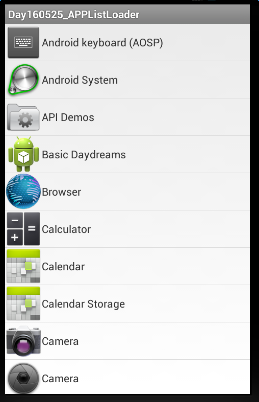
打开应用,AppListLoader中核心方法执行的先后顺序:
05-25 12:57:46.050 11184-11184/com.troy.applistloader I/TAG: +++ Calling initLoader()! +++
05-25 12:57:46.050 11184-11184/com.troy.applistloader I/TAG: +++ Initializing the new Loader... +++
05-25 12:57:46.050 11184-11184/com.troy.applistloader I/TAG: onCreateLoader()
05-25 12:57:46.050 11184-11184/com.troy.applistloader I/TAG: onStartLoading()
05-25 12:57:46.060 11184-11184/com.troy.applistloader I/TAG: forceLoad()
05-25 12:57:46.060 11184-13196/com.troy.applistloader I/TAG: loadInBackground()
05-25 12:57:47.530 11184-11184/com.troy.applistloader I/TAG: deliverResult()
05-25 12:57:47.530 11184-11184/com.troy.applistloader I/TAG: onLoadFinished()
返回键,会执行的方法及执行顺序:
05-25 13:00:08.790 11184-11184/com.troy.applistloader I/TAG: onStopLoading()
05-25 13:00:08.790 11184-11184/com.troy.applistloader I/TAG: onLoaderReset()
05-25 13:00:08.790 11184-11184/com.troy.applistloader I/TAG: onReset()
05-25 13:00:08.790 11184-11184/com.troy.applistloader I/TAG: onStopLoading()
三 总结
本项目的学习之后,我们应该掌握以下几点:
(1)理解AsyncTaskLoader的每一个核心方法的作用及调用时机,以及如何自定义一个AsyncTaskLoader。
(2)如何在Fragement中启动AsyncTaskLoader,继承LoaderManager.LoaderCallbacks,实现接口的三个方法。
(3)应该了解AsyncTaskLoader的底层实际上是执行的AsyncTask,这个可以看看源码。
(4)如何应用ApplicationInfo,获取相关的程序信息。